Tracy confronts Charlie and is injured
Hide and SeekTracy’s confrontation with Charlie turns blame over Ronnie’s death into a personal rupture, leaving her injured and seeking refuge with John Rebus. Her account also makes clear the limits of her influence over Ronnie: she believed he understood what he was doing and would not listen to anyone who tried to change his course.
Arrival and Account
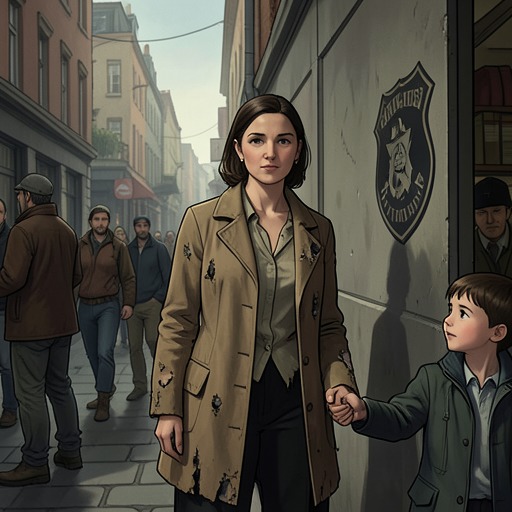
Rebus approaches a boarded-up house not far from where Ronnie died, where two police constables are waiting outside. Before leaving his car, he takes the keys from the ignition and locks the driver’s door, a small precaution in an area he treats as unsafe. At the house, Tracy opens the door before he reaches it. Her eyes are reddened from crying, and one is bruised; she appears relieved to see him and embraces him as her tears begin again.
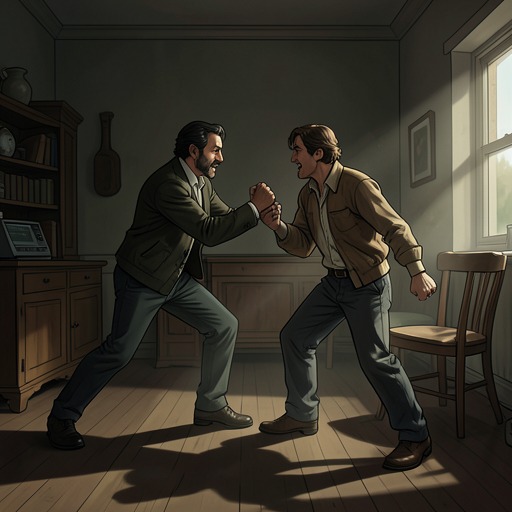
Tracy explains that she and Charlie argued after he blamed her for Ronnie’s death. Charlie had said she should have looked after Ronnie, stopped him taking drugs, and got him away from Pilmuir. She rejects the accusation, explaining that Ronnie would not have listened to her: she had thought he knew what he was doing, and nobody could tell him otherwise. Her account places the conflict not only in Charlie’s accusation but in the helplessness it invokes—Tracy is made answerable for decisions she says she could not control.
The Fight and Its Immediate Aftermath
Rebus pieces together the escalation: Charlie shouted at Tracy, she shouted back, and he struck her. Tracy does not present herself as having remained passive in the argument, but the exchange ended with her injured. When the constables arrived at one entrance, Charlie escaped through the back door. His departure left Tracy to recount the confrontation to Rebus, while the police presence marks the point at which their private dispute became part of the investigation.
The Personal Dispute and the Murder Inquiry
The confrontation does not resolve who was responsible for Ronnie’s death: Tracy rejects Charlie’s accusation, while her account describes Ronnie as unwilling to accept anyone else’s direction. The wider inquiry remains open to a more serious explanation than personal failure. When John Rebus later visits Matthew Vanderhyde, he identifies the matter as a murder or, at minimum, interference with evidence at the scene of a death. That investigative framing gives the quarrel over Ronnie’s choices a sharper context, without establishing that Tracy or Charlie knows who caused his death.
Later Investigation and Public Record
The confrontation at Charlie’s house belongs to an inquiry that soon becomes difficult for John Rebus to pursue openly. Rebus calls the case against him a setup, and Superintendent Watson tells him to step away for a day or two, promising that the account used against him will be dismantled. The response shows how quickly the investigation’s focus can shift from Ronnie’s death to the conduct and credibility of the officers involved; it does not, however, settle the blame exchanged between Tracy and Charlie.
Even while officially excluded, Rebus stays close to the later questioning of Malcolm Lanyon. He knows the answers to the investigators’ questions and the kinds of tactics Lanyon might use, and fears that a technicality could let him evade accountability. The public aftermath is narrower than this determination suggests: reports acknowledge the deaths of Finlay Andrews and Lanyon and describe a club whose dealings were not entirely legitimate, but disclose no details of its activities. Against that muted record, Tracy’s account of the argument remains a personal testimony to the limits of assigning responsibility for Ronnie’s choices—not a resolution of how he died or who caused it.